
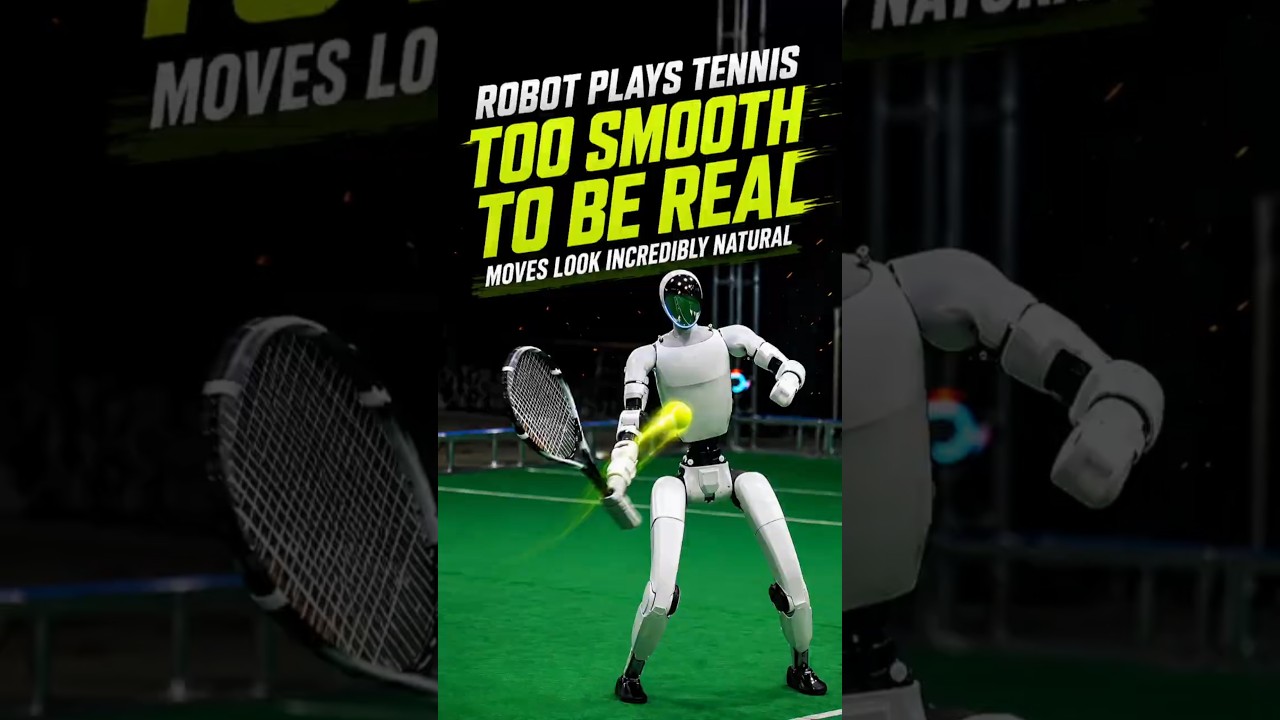
In a short clip that has been quietly making the rounds, a robot steps onto a tennis court and does something that used to belong only to trained athletes: it watches an incoming ball, works out where it needs to be, and moves there — smoothly, promptly, and with an economy of motion that looks almost casual. No hesitation, no stagger, no visible “thinking pause.” Just perception, decision, and action compressed into a couple of seconds.
Why does that stop people mid-scroll? Because most of the robots we see in daily life are repetition machines — arms bolting the same weld in the same spot a thousand times a day. A tennis court is the opposite environment. It is open, dynamic, and utterly unforgiving of delay. The ball does not wait for the robot to finish computing.
It starts with perception. To intercept a tennis ball, the machine first has to see it — a small, fast object crossing a visually busy background of lines, net, and sky. Onboard cameras feed computer-vision models that track the ball frame by frame, estimate its position in three dimensions, and project its flight path forward: where it will travel, how it will drop, where it will land. All of that has to happen while the ball is still in the air.
But prediction alone is not a decision. The robot must then weigh its options: is the projected intercept point reachable in time? Should it commit now or hold position for a better angle? Move early and fast, or late and precise? A human player calls this anticipation and calls it instinct. Inside the machine, it is planning under uncertainty — a calculation that balances speed, reach, and stability, and that has to be re-run every time the situation changes.
The most impressive part of the clip, though, is not the thinking — it is the moving. Crossing a court quickly demands dynamic balance: leaning into acceleration, absorbing direction changes, correcting footwork on the fly. Deftness like that does not come from brute motor power; it comes from control software tuned until each step lands where the plan needs it. Watch the small adjustment steps near the end of each move. Those are the hardest ones to get right.
Tennis, it turns out, is close to a perfect stress test for embodied AI. The ball is small and fast. Spin changes its bounce in ways that are awkward to model exactly. Lighting shifts, backgrounds clutter, and the margin for error is measured in milliseconds. That is exactly why scenes like this one keep appearing from robotics labs — a court is a compact stage where every weakness in perception, planning, and motion control is exposed at full speed.
What makes the moment feel different is how unremarkable the hardware looks while all of this happens. The loop — see, decide, move, correct — runs continuously, with each cycle measured in milliseconds, on compute light enough to ride along with the machine. There is no external crane of processing power holding it up. The intelligence travels with the body.
And that loop is the real story, because it generalizes far beyond sport. A warehouse robot rerouting around a dropped box, a delivery bot choosing a safer crossing, a future home assistant reaching for a fragile glass — every one of them lives or dies by the same three-beat rhythm of perception, decision, and agile movement. The tennis court is simply where that rhythm is easiest to see.
Sporting demos have long been the robotics world’s favorite way to show off. Table-tennis-playing arms have been trading rallies with visitors for years, and every generation of walking machines seems to get filmed kicking a ball or taking a swing at something. The reason is simple: audiences do not need a spec sheet to judge the performance. Anyone who has ever mishit a backhand knows instantly how hard this is. A tennis court makes the engineering legible to everyone at once.
So when you watch the clip, watch it twice. On the first pass, enjoy the deftness — it is genuinely fun to see. On the second, pick a single moment: the instant the robot commits to a direction. Notice how early it starts moving, and how many tiny corrections happen between commitment and arrival. That gap between deciding and doing, closed this cleanly, is where years of engineering quietly live.
A robot making a decision and moving deftly on a tennis court is a thirty-second video. But the distance it represents — from machines that repeat to machines that respond — is the distance the entire field of robotics has spent decades crossing. Clips like this are how you notice it has been crossed.